
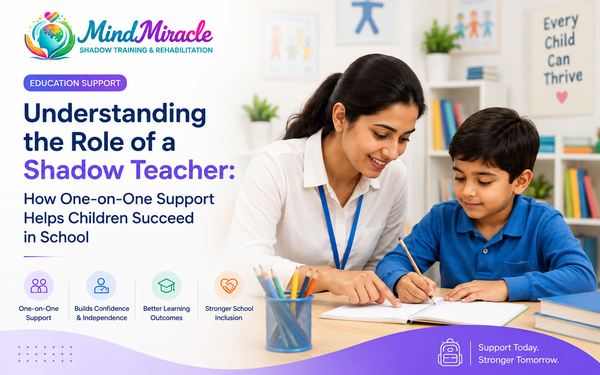
Understanding the Role of a Shadow Teacher: How One-on-One Support Helps Children Succeed in School
Every parent wants their child to feel confident, included, and successful at school. However, some children may experience challenges with communication, attention, social interaction, learning, or emotional regulation. These difficulties can make a mainstream classroom overwhelming.
A Shadow Teacher for Children in School provides personalized one-on-one support to help children participate confidently and independently. At Mind Miracle, our Shadow Training program connects home, school, and learning to create a supportive environment for every child.
What is Shadow Training?
Shadow Training is a specialized educational support service in which a trained professional assists a child within a mainstream classroom. Unlike the classroom teacher, a shadow teacher focuses on the individual child's academic, behavioral, communication, and social needs.
The goal is not to complete tasks for the child but to guide them toward independence. A shadow teacher may help the child understand instructions, remain focused, participate in activities, manage transitions, and communicate effectively.
Key Benefits of a Shadow Teacher
1. Personalized Classroom Support
Every child learns differently. A shadow teacher adapts support according to the child's strengths, needs, and learning pace. This may include breaking difficult tasks into smaller steps, providing reminders, encouraging classroom participation, and developing organizational skills.
2. Social Interaction and Inclusion
School plays an important role in developing friendships and social skills. Children who struggle with social communication may find group activities challenging.
A shadow teacher encourages positive peer interactions, helps children understand social cues and classroom routines, and supports participation in group activities. This school inclusion support helps children become active members of their classroom community.
3. Behavioral Regulation and Focus
Children with attention, sensory, or emotional regulation difficulties may require additional classroom support. Shadow teachers can use strategies such as positive reinforcement, visual schedules, calm redirection, and emotional regulation techniques.
The objective is to help children understand expectations, manage emotions, improve focus, and gradually develop self-control.
4. Collaboration with Parents and Teachers
Effective support requires teamwork. Shadow teachers work closely with parents, classroom teachers, therapists, special educators, and school management. Regular communication helps maintain consistent strategies across home, school, and therapy environments.
Who Can Benefit from Shadow Training?
Shadow Training may support children with Autism Spectrum Disorder (ASD), ADHD, learning disabilities, developmental delays, speech and language difficulties, sensory processing challenges, social communication difficulties, or behavioral and emotional regulation needs.
Since every child is different, professional assessment is important to determine the appropriate level of support.
Mind Miracle's Approach
At Mind Miracle, Shadow Training is personalized according to each child's developmental and educational goals. Individualized support plans may focus on academic participation, communication, social interaction, emotional regulation, behavior, and classroom independence.
Our trained and compassionate professionals encourage children through patience and positive guidance. Progress is regularly monitored so strategies can be adjusted as the child's abilities develop.
Building Confidence One Step at a Time
A shadow teacher does more than provide classroom assistance. The aim is to help children develop confidence, independence, communication skills, positive relationships, and meaningful participation in school life.
At Mind Miracle, we work with families, educators, and professionals to create supportive learning experiences that help children progress toward greater independence—one milestone at a time.